

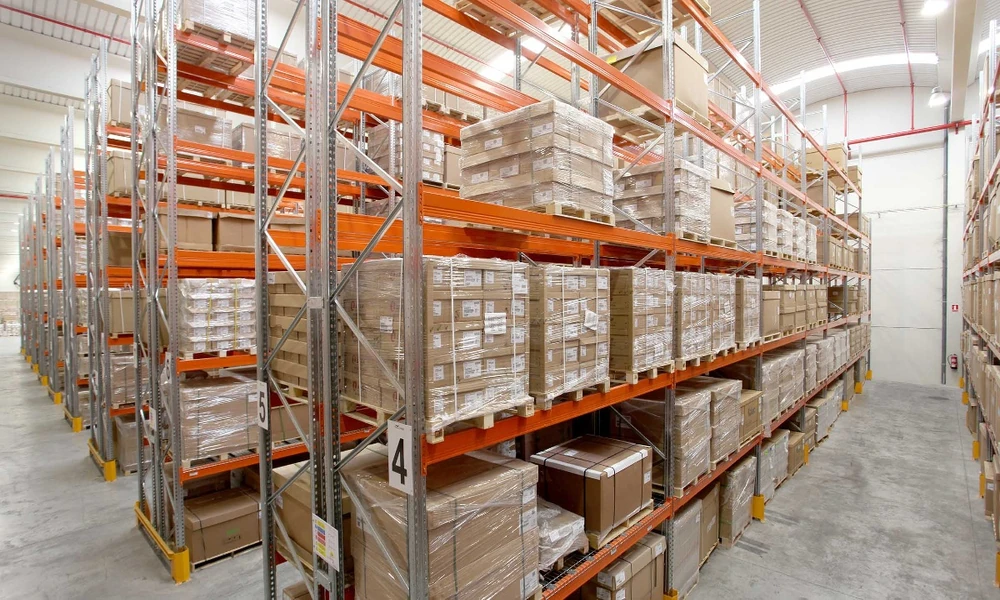
Warehouse managers sometimes regard racking as a fixed asset in the most literal sense: once it is up, the beam levels stay where they were set on day one. That habit wastes the main advantage of the design. With adjustable racking for palletised goods, the beams clip into slotted uprights at regular intervals and can be moved as the stock changes. Understanding what that adjustability offers, and where its limits lie, helps a warehouse extract far more value from the same steel.
What Adjustable Means in Practice
The upright frames are punched along their full height with slots at a fixed pitch, commonly fifty or seventy-five millimetres. Beams carry hooked connectors that drop into those slots and are secured with a locking pin. Nothing is welded in position. A level can therefore be raised, lowered, added or removed with hand tools once the bay has been emptied, and the structure remains the same tested system provided the new arrangement falls within its rated loads.
Direct Access to Every Pallet
In the standard one-deep arrangement each pallet faces an aisle. Any load can be picked without disturbing another, which keeps handling quick and stock records simple. Location errors are fewer because every position has its own address and nothing is hidden behind anything else. For operations that pick by order, hold many product lines or need to carry out regular stock counts, this plain visibility is worth more than a higher pallet count achieved with deeper storage.
Fitting Beam Levels to the Load
Pallets are rarely the same height. Setting every level to suit the tallest load leaves wasted air above the shorter ones, repeated across hundreds of bays. Adjusting beam spacing to the actual height of what is stored, allowing the necessary clearance for the truck to lift in and out, can release an additional level in many bays. The gain costs nothing in steel and is among the simplest ways to raise capacity in an existing installation.
Reconfiguring as the Range Changes
Product ranges do not stand still. A new customer, a packaging redesign or a shift from full pallets to half pallets can make yesterday’s layout a poor fit. Fixed structures would need replacing. Here the bays are simply re-levelled, and frames can be unbolted and relocated if the floor plan itself must change. This ability to follow the business is why adjustable racking for palletised goods tends to remain useful through several changes of tenant, product or premises during its working life.
Compatibility With Ordinary Trucks
The system does not dictate specialised handling equipment. Counterbalance forklifts, reach trucks and stackers can all work it, provided the aisle width suits the truck’s turning requirement and its lift height reaches the top beam with adequate residual capacity. A business can therefore start with the trucks it already owns and later move to narrower aisles and different equipment if space becomes tight, keeping the same frames and beams and re-spacing the runs.
Accessories That Extend Its Use
Because the frame and beam geometry is standard, a wide range of fittings can be added. Wire mesh or timber decking turns a level into shelving for cartons. Pallet support bars carry undersized or weak pallets. Drum cradles, coil supports and fork entry bars adapt bays to awkward loads. The lowest levels are often converted to carton pick faces with reserve pallets above, creating a combined picking and storage location within one footprint.
Extending in Height and Length
A run can be lengthened by adding bays that share an upright frame with the existing end bay, which costs less per position than starting afresh. Where frames were specified with spare height, further beam levels can be added later. Both options depend on the original load calculations and on matching components from the same manufacturer, so the design documents should be kept. Growth planned at the outset is far cheaper than growth improvised afterwards.
The Limits That Come With Flexibility
Adjustability does not mean beams can go anywhere. Frame capacity falls as the height to the first beam, or the gap between levels, increases, because the upright has a greater unsupported length. Moving beams without checking the load tables can therefore reduce the safe bay load even though the pallets weigh the same as before. Any change of configuration should be confirmed against the supplier’s data and followed by updated load notices at the end of the run.
Inspection, Repair and Resale
Bolted and clipped components are straightforward to inspect and to replace individually. A beam struck by a fork or an upright dented by a truck can be swapped without dismantling the run, which keeps repair costs proportionate to the damage. Standard systems from established manufacturers also hold a second-hand value and can be dismantled and re-erected at a new site, something that cannot be said of bespoke welded structures.
Is It the Right Choice for Your Warehouse?
For most general warehouses the answer is yes, at least for part of the building. If the range is broad, pallet sizes vary and the business expects to change, adjustable racking for palletised goods provides access and flexibility that denser systems cannot. Where a few lines are held in very deep stocks, lane storage may suit that portion better. The practical step is to list pallet dimensions, weights and movement rates, and have a supplier design the beam levels around those facts.


